异常处理
这里回看一下第一章的登录流程分析。
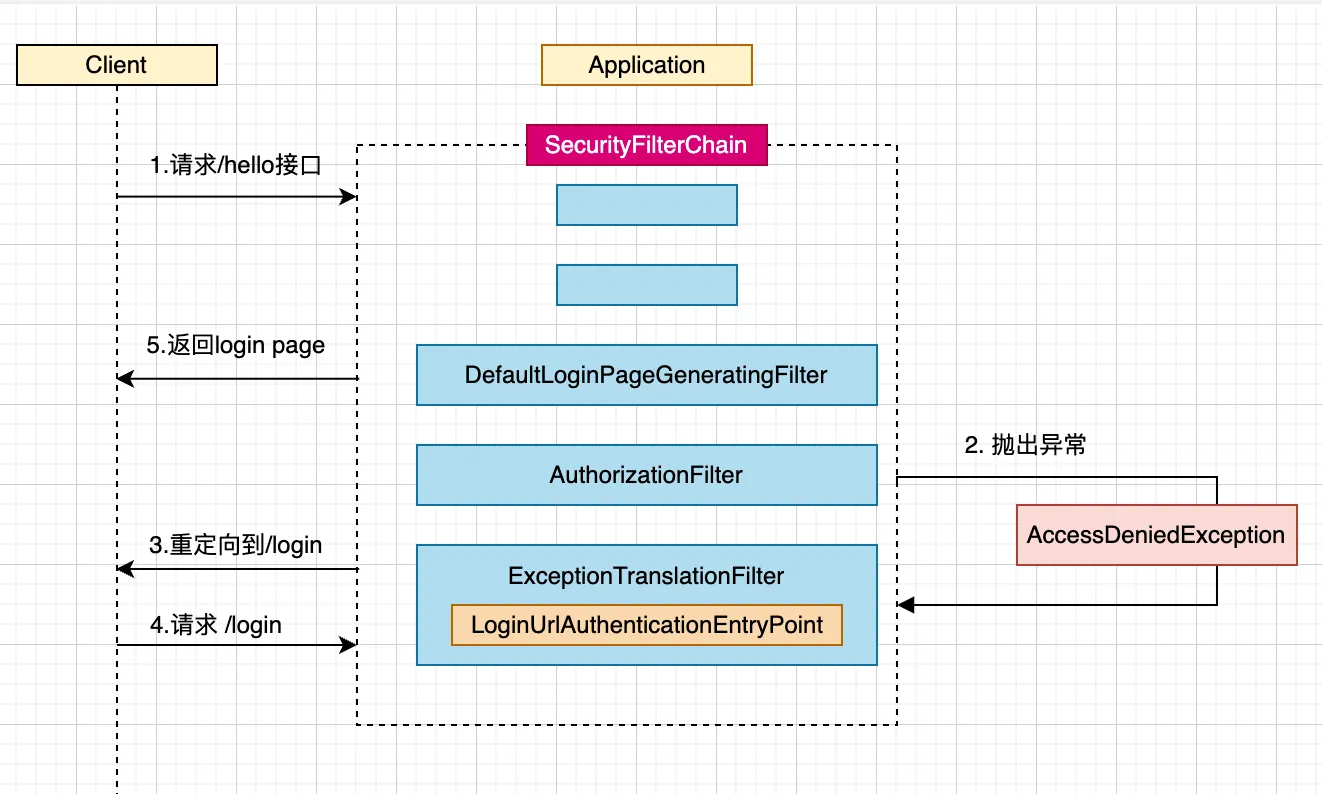
之前有提到过如果用户的请求未经过认证,会在AuthorizationFilter中被拦截,然后抛出AccessDeniedException异常,然后异常会被ExceptionTranslationFilter捕获,重定向到登录页面。本章节就来详细分析这个流程。
通过查看FilterOrderRegistration的过滤器链顺序,我们可以知道AuthorizationFilter的优先级排倒数第二,ExceptionTranslationFilter排倒数第四,所以可以知道如果前面的过滤器没有异常,必然最后会经过这两个过滤器。
ExceptionHandlingConfigurer
@Configuration(proxyBeanMethods = false)
class HttpSecurityConfiguration {
  @Bean(HTTPSECURITY_BEAN_NAME)
  @Scope("prototype")
  HttpSecurity httpSecurity() throws Exception {
    HttpSecurity http = new HttpSecurity(this.objectPostProcessor, authenticationBuilder, createSharedObjects());
    http.exceptionHandling(withDefaults())
    return http;
  }
}先看httpSecurity Bean的声明函数,可以看到调用了exceptionHandling,而这个方法引入了ExceptionHandlingConfigurer。
public final class HttpSecurity extends AbstractConfiguredSecurityBuilder<DefaultSecurityFilterChain, HttpSecurity>
		implements SecurityBuilder<DefaultSecurityFilterChain>, HttpSecurityBuilder<HttpSecurity> {

  public HttpSecurity exceptionHandling(
			Customizer<ExceptionHandlingConfigurer<HttpSecurity>> exceptionHandlingCustomizer) throws Exception {
		exceptionHandlingCustomizer.customize(getOrApply(new ExceptionHandlingConfigurer<>()));
		return HttpSecurity.this;
	}
}按照惯例,我们看一下ExceptionHandlingConfigurer的方法,由于该类没有实现init方法,直接看configure方法
public final class ExceptionHandlingConfigurer<H extends HttpSecurityBuilder<H>>
		extends AbstractHttpConfigurer<ExceptionHandlingConfigurer<H>, H> {
  @Override
  public void configure(H http) {
    AuthenticationEntryPoint entryPoint = getAuthenticationEntryPoint(http);
    ExceptionTranslationFilter exceptionTranslationFilter = new ExceptionTranslationFilter(entryPoint,
        getRequestCache(http));
    AccessDeniedHandler deniedHandler = getAccessDeniedHandler(http);
    exceptionTranslationFilter.setAccessDeniedHandler(deniedHandler);
    exceptionTranslationFilter.setSecurityContextHolderStrategy(getSecurityContextHolderStrategy());
    exceptionTranslationFilter = postProcess(exceptionTranslationFilter);
    http.addFilter(exceptionTranslationFilter);
  }

  AuthenticationEntryPoint getAuthenticationEntryPoint(H http) {
    AuthenticationEntryPoint entryPoint = this.authenticationEntryPoint;
    if (entryPoint == null) {
      entryPoint = createDefaultEntryPoint(http);
    }
    return entryPoint;
  }
}可以看到往过滤器中加入了一个异常过滤器:ExceptionTranslationFilter
ExceptionTranslationFilter
Spring Security中的异常处理主要是在ExceptionTranslationFilter中完成的,该过滤器主要处理AuthenticationException和AccessDeniedException异常,其他的异常则继续抛出。我们先来看看代码
public class ExceptionTranslationFilter extends GenericFilterBean implements MessageSourceAware {
  private void doFilter(HttpServletRequest request, HttpServletResponse response, FilterChain chain)
      throws IOException, ServletException {
    try {
      chain.doFilter(request, response);
    }
    catch (IOException ex) {
      throw ex;
    }
    catch (Exception ex) {
      // Try to extract a SpringSecurityException from the stacktrace
      Throwable[] causeChain = this.throwableAnalyzer.determineCauseChain(ex);
      // 看是不是AuthenticationException
      RuntimeException securityException = (AuthenticationException) this.throwableAnalyzer
        .getFirstThrowableOfType(AuthenticationException.class, causeChain);
      // 如果不是AuthenticationException,看是不是AccessDeniedException
      if (securityException == null) {
        securityException = (AccessDeniedException) this.throwableAnalyzer
          .getFirstThrowableOfType(AccessDeniedException.class, causeChain);
      }
      // 如果都不是,重新抛出去
      if (securityException == null) {
        rethrow(ex);
      }
      // 如果已经响应客户端,则抛出ServletException异常
      if (response.isCommitted()) {
        throw new ServletException("Unable to handle the Spring Security Exception "
            + "because the response is already committed.", ex);
      }
      // 处理AuthenticationException或者AccessDeniedException
      handleSpringSecurityException(request, response, chain, securityException);
    }
  }

  private void handleSpringSecurityException(HttpServletRequest request, HttpServletResponse response,
      FilterChain chain, RuntimeException exception) throws IOException, ServletException {
    if (exception instanceof AuthenticationException) {
      handleAuthenticationException(request, response, chain, (AuthenticationException) exception);
    }
    else if (exception instanceof AccessDeniedException) {
      handleAccessDeniedException(request, response, chain, (AccessDeniedException) exception);
    }
  }
}AuthenticationException
我们先看处理AuthenticationException(认证异常)的流程。
public class ExceptionTranslationFilter extends GenericFilterBean implements MessageSourceAware {
  private void handleAuthenticationException(HttpServletRequest request, HttpServletResponse response,
        FilterChain chain, AuthenticationException exception) throws ServletException, IOException {
      this.logger.trace("Sending to authentication entry point since authentication failed", exception);
      sendStartAuthentication(request, response, chain, exception);
    }

  protected void sendStartAuthentication(HttpServletRequest request, HttpServletResponse response, FilterChain chain,
      AuthenticationException reason) throws ServletException, IOException {
    // SEC-112: Clear the SecurityContextHolder's Authentication, as the
    // existing Authentication is no longer considered valid
    SecurityContext context = this.securityContextHolderStrategy.createEmptyContext();
    this.securityContextHolderStrategy.setContext(context);
    this.requestCache.saveRequest(request, response);
    this.authenticationEntryPoint.commence(request, response, reason);
  }
}主要做了三件事,清除请求中的认证主体,保存当前请求,调用authenticationEntryPoint.commence的失败认证方法。我们看看authenticationEntryPoint是在哪里初始化的。
public final class ExceptionHandlingConfigurer<H extends HttpSecurityBuilder<H>>
		extends AbstractHttpConfigurer<ExceptionHandlingConfigurer<H>, H> {

  private AuthenticationEntryPoint authenticationEntryPoint;

  @Override
  public void configure(H http) {
    AuthenticationEntryPoint entryPoint = getAuthenticationEntryPoint(http);
    ExceptionTranslationFilter exceptionTranslationFilter = new ExceptionTranslationFilter(entryPoint,
      getRequestCache(http));
    ...
  }

  public ExceptionHandlingConfigurer<H> authenticationEntryPoint(AuthenticationEntryPoint authenticationEntryPoint) {
    this.authenticationEntryPoint = authenticationEntryPoint;
    return this;
  }

  AuthenticationEntryPoint getAuthenticationEntryPoint(H http) {
    AuthenticationEntryPoint entryPoint = this.authenticationEntryPoint;
    if (entryPoint == null) {
      entryPoint = createDefaultEntryPoint(http);
    }
    return entryPoint;
  }

  private LinkedHashMap<RequestMatcher, AuthenticationEntryPoint> defaultEntryPointMappings = new LinkedHashMap<>();

  public ExceptionHandlingConfigurer<H> defaultAuthenticationEntryPointFor(AuthenticationEntryPoint entryPoint,
      RequestMatcher preferredMatcher) {
    this.defaultEntryPointMappings.put(preferredMatcher, entryPoint);
    return this;
  }

  private AuthenticationEntryPoint createDefaultEntryPoint(H http) {
    if (this.defaultEntryPointMappings.isEmpty()) {
      return new Http403ForbiddenEntryPoint();
    }
    if (this.defaultEntryPointMappings.size() == 1) {
      return this.defaultEntryPointMappings.values().iterator().next();
    }
    DelegatingAuthenticationEntryPoint entryPoint = new DelegatingAuthenticationEntryPoint(
        this.defaultEntryPointMappings);
    entryPoint.setDefaultEntryPoint(this.defaultEntryPointMappings.values().iterator().next());
    return entryPoint;
  }
}可以看到有两种方法可以定义。
- 如果this.authenticationEntryPoint存在,那么返回this.authenticationEntryPoint,通过authenticationEntryPoint配置
- 如果this.authenticationEntryPoint不存在,则基于defaultEntryPointMappings构建一个复合DelegatingAuthenticationEntryPoint,这个可以耦合很多个authenticationEntryPoint,从中筛选。
让我们查看DelegatingAuthenticationEntryPoint的处理方法,代码如下。
public class DelegatingAuthenticationEntryPoint implements AuthenticationEntryPoint, InitializingBean {
  @Override
  public void commence(HttpServletRequest request, HttpServletResponse response,
      AuthenticationException authException) throws IOException, ServletException {
    for (RequestMatcher requestMatcher : this.entryPoints.keySet()) {
      if (requestMatcher.matches(request)) {
        AuthenticationEntryPoint entryPoint = this.entryPoints.get(requestMatcher);
        entryPoint.commence(request, response, authException);
        return;
      }
    }
    logger.debug(LogMessage.format("No match found. Using default entry point %s", this.defaultEntryPoint));
    // No EntryPoint matched, use defaultEntryPoint
    this.defaultEntryPoint.commence(request, response, authException);
  }
}可以看到会遍历entryPoints集合中entryPoint的的matches函数,如果复合,就调用entryPoint的commence方法。为了扩展性,还是推荐使用第二种方法。
- 表单登录在AbstractAuthenticationFilterConfigurer#registerAuthenticationEntryPoint中会向defaultEntryPointMappings加入一个LoginUrlAuthenticationEntryPoint,自动跳转到登录页面
- HttpBasic在HttpBasicConfigurer#registerDefaultEntryPoint中向defaultEntryPointMappings加入一个BasicAuthenticationEntryPoint,返回认证请求
AccessDeniedException
我们再看一下AccessDeniedException的处理,
public class ExceptionTranslationFilter extends GenericFilterBean implements MessageSourceAware {
  private void handleAccessDeniedException(HttpServletRequest request, HttpServletResponse response,
      FilterChain chain, AccessDeniedException exception) throws ServletException, IOException {
    Authentication authentication = this.securityContextHolderStrategy.getContext().getAuthentication();
    boolean isAnonymous = this.authenticationTrustResolver.isAnonymous(authentication);
    // 如果是匿名用户,或者是通过Remember登录的,则调用AuthenticationException处理
    if (isAnonymous || this.authenticationTrustResolver.isRememberMe(authentication)) {
      // 可以看到处理跟上面的AuthenticationException一样
      sendStartAuthentication();
    }
    else {
      // 否则调用accessDeniedHandler.handle
      this.accessDeniedHandler.handle(request, response, exception);
    }
  }
}由于accessDeniedHandler的处理跟authenticationEntryPoint类似,可以直接参照源码解读。
扩展点
- accessDeniedHandler: 定义匿名用户权限异常问题
- authenticationEntryPoint: 定义实名用户权限异常问题
由于现在基本上都是前后端分离相关,我们写一个未登录用户访问资源报错的Demo。直接拿之前的代码做修改。
新增一个CustomerHandler文件,用来处理异常认证请求。代码如下
public class CustomerHandler {
  public static void commence(HttpServletRequest request, HttpServletResponse response, AuthenticationException authException) throws IOException {
    ObjectMapper objectMapper = BeanUtil.getBean(ObjectMapper.class);
    CustomResponseImpl failureResponse = new CustomResponseImpl();
    failureResponse.setCode("401");
    failureResponse.setMsg("没有权限访问该路径,请登录后重试");
    response.setHeader(HttpHeaders.CONTENT_TYPE, "application/json;charset=UTF-8");
    response.getWriter().write(objectMapper.writeValueAsString(failureResponse));
  }
}SecurityConfig文件代码如下:
@Configuration
public class DefaultSecurityConfig {
  @Bean
  SecurityFilterChain apiSecurityFilterChain(HttpSecurity http) throws Exception {
    http.authorizeHttpRequests(requests -> requests.anyRequest().authenticated());
    http.formLogin(Customizer.withDefaults());
    http.exceptionHandling(exceptionHandling -> exceptionHandling.authenticationEntryPoint(CustomerHandler::commence));
    return http.build();
  }
}启动项目,打开浏览器直接访问/user接口,窗口直接返回认证失败的错误信息。
{"msg":"没有权限访问该路径,请登录后重试","status":401}具体代码,点击此处
AuthorizationFilter
那么ExceptionTranslationFilter捕获的异常是在哪里获取的呢,是在ExceptionTranslationFilter抛出的。查看AuthorizationFilter的doFilter
public class AuthorizationFilter extends GenericFilterBean {
  @Override
  public void doFilter(ServletRequest servletRequest, ServletResponse servletResponse, FilterChain chain)
      throws ServletException, IOException {

    HttpServletRequest request = (HttpServletRequest) servletRequest;
    HttpServletResponse response = (HttpServletResponse) servletResponse;

    if (this.observeOncePerRequest && isApplied(request)) {
      chain.doFilter(request, response);
      return;
    }

    if (skipDispatch(request)) {
      chain.doFilter(request, response);
      return;
    }

    String alreadyFilteredAttributeName = getAlreadyFilteredAttributeName();
    request.setAttribute(alreadyFilteredAttributeName, Boolean.TRUE);
    try {
      AuthorizationResult result = this.authorizationManager.authorize(this::getAuthentication, request);
      this.eventPublisher.publishAuthorizationEvent(this::getAuthentication, request, result);
      // 如果权限异常,那么抛出AuthorizationDeniedException
      if (result != null && !result.isGranted()) {
        throw new AuthorizationDeniedException("Access Denied", result);
      }
      chain.doFilter(request, response);
    }
    finally {
      request.removeAttribute(alreadyFilteredAttributeName);
    }
  }
}AuthorizationFilter是在AuthorizeHttpRequestsConfigurer中加入的,AuthorizeHttpRequestsConfigurer是什么时候配置的呢,我们看security的配置文件。
@Configuration
public class DefaultSecurityConfig {
  @Bean
  SecurityFilterChain apiSecurityFilterChain(HttpSecurity http) throws Exception {
    // 就是在这一行,如果把这行代码注释掉,就会发现资源没有登录的话也会返回了
    http.authorizeHttpRequests(requests -> requests.anyRequest().authenticated());
    http.formLogin(Customizer.withDefaults());
    return http.build();
  }
}注意AuthorizationFilter的AuthorizationManage跟HttpSecurity里面的不是同一个,是自定义的,可以看AuthorizeHttpRequestsConfigurer的configure方法。
public final class AuthorizeHttpRequestsConfigurer<H extends HttpSecurityBuilder<H>>
		extends AbstractHttpConfigurer<AuthorizeHttpRequestsConfigurer<H>, H> {
  @Override
  public void configure(H http) {
    // 在这里创建的
    AuthorizationManager<HttpServletRequest> authorizationManager = this.registry.createAuthorizationManager();
    AuthorizationFilter authorizationFilter = new AuthorizationFilter(authorizationManager);
    authorizationFilter.setAuthorizationEventPublisher(this.publisher);
    authorizationFilter.setShouldFilterAllDispatcherTypes(this.registry.shouldFilterAllDispatcherTypes);
    authorizationFilter.setSecurityContextHolderStrategy(getSecurityContextHolderStrategy());
    http.addFilter(postProcess(authorizationFilter));
  }
}默认使用RequestMatcherDelegatingAuthorizationManager的check做校验。
public final class RequestMatcherDelegatingAuthorizationManager implements AuthorizationManager<HttpServletRequest> {
  @Deprecated
  @Override
  public AuthorizationDecision check(Supplier<Authentication> authentication, HttpServletRequest request) {
    ...
    for (RequestMatcherEntry<AuthorizationManager<RequestAuthorizationContext>> mapping : this.mappings) {
      RequestMatcher matcher = mapping.getRequestMatcher();
      MatchResult matchResult = matcher.matcher(request);
      if (matchResult.isMatch()) {
        return manager.check(authentication, new RequestAuthorizationContext(request, matchResult.getVariables()));
      }
    }
    return DENY;
  }
}可以看到是遍历this.mappings来做处理,很容易就知道,就是在配置文件中加入的,像上面的requests.anyRequest().authenticated(),进入源码上看一下
public final class AuthorizeHttpRequestsConfigurer<H extends HttpSecurityBuilder<H>>
		extends AbstractHttpConfigurer<AuthorizeHttpRequestsConfigurer<H>, H> {
  public AuthorizationManagerRequestMatcherRegistry authenticated() {
    return access(AuthenticatedAuthorizationManager.authenticated());
  }

  public AuthorizationManagerRequestMatcherRegistry access(
      AuthorizationManager<RequestAuthorizationContext> manager) {
    Assert.notNull(manager, "manager cannot be null");
    return (this.not)
        ? AuthorizeHttpRequestsConfigurer.this.addMapping(this.matchers, AuthorizationManagers.not(manager))
        : AuthorizeHttpRequestsConfigurer.this.addMapping(this.matchers, manager);
  }
}